Research
Planning and perception for robots that must act under uncertainty without GPS.
Vision
To build robots that can be trusted in these settings, I develop autonomy frameworks in which uncertainty is explicit at every stage: in how the robot models its world, assesses the value of information, and makes decisions. Because the uncertainty is explicit, each decision is interpretable, whether the planner is classical or learned: it can be broken down into what the robot believed, the risk it accepted, and the information it expected to gain.
Much of my work to date uses magnetic navigation as a model problem. Earth’s crustal field is passive and hard to jam, which makes it attractive when GPS is denied, but it is weak and sparsely mapped, so a robot relying on it cannot ignore uncertainty. I have also built and fielded the systems these ideas run on, including the software stack for an underwater vehicle, a gesture-driven diver-following controller, research drones, and an Isaac Sim digital twin.
Research Threads
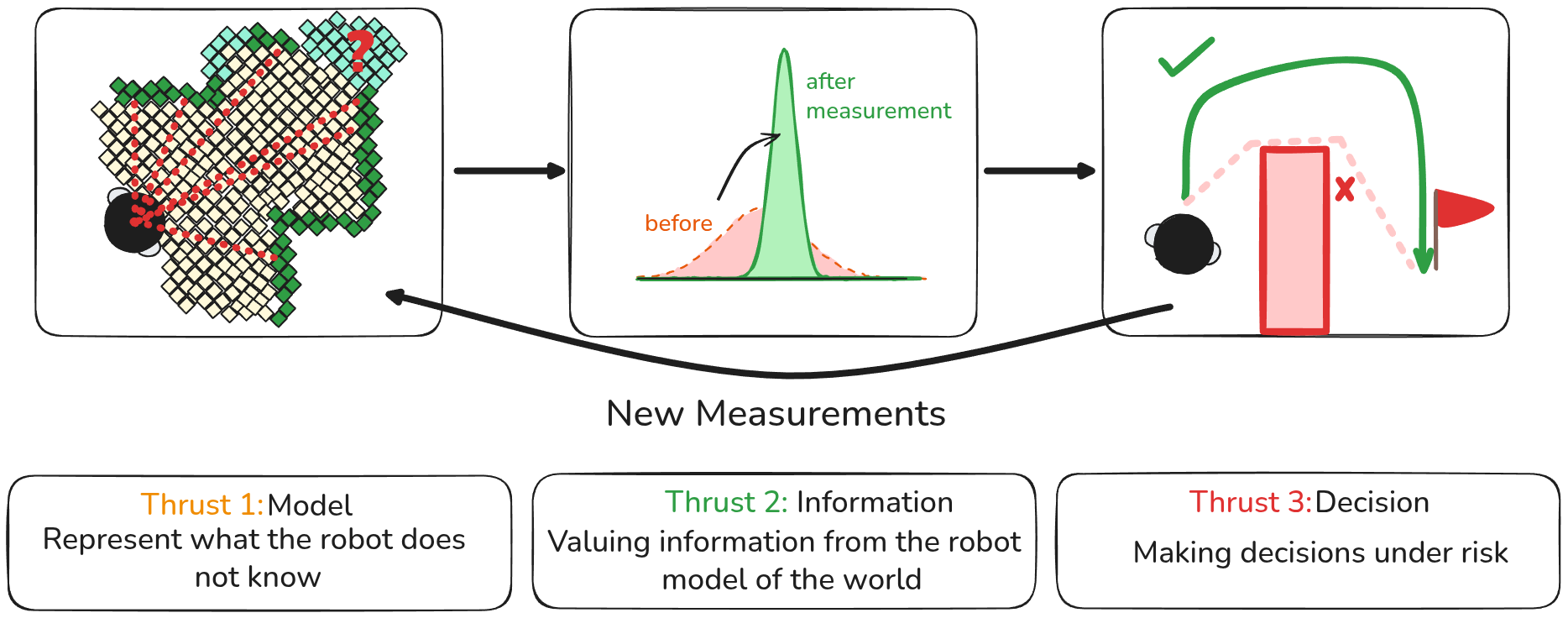
Thrust 1: Representing What the Robot Does Not Know
Maps and sensor models that say how uncertain they are. BEAMM builds expandable magnetic field maps with calibrated uncertainty, a neural magnetometer model supports virtual testing, and multimodal RGB and sonar work (calibration and the uScenes dataset) gives underwater robots richer representations to reason over.
Thrust 2: Active Perception and the Value of Information
Deciding where to sense, not just where to go. HALo characterizes how field gradients determine localizability, and my information-driven planner uses that to choose paths that keep the robot localized, improving localization accuracy by 5% and cutting failure rates by 34% over state-of-the-art methods.
Thrust 3: Deciding Under Risk with Classical and Learned Planners
Turning belief into action, whether the planner is classical or learned. B-COD conditions a one-step diffusion planner on the robot’s belief for real-time trajectories with just-enough sensing, and the real-time magnetic planner reduces compute by over 99%. Akule extends diffusion planning to multi-robot teams.
Systems I have built to test these ideas: the software stack for an underwater vehicle, a gesture-driven diver-following controller, research drones, and an Isaac Sim digital twin.
Collaborations
Melkior Ornik’s group
Joint work on belief-conditioned and multi-robot diffusion planning with students Gokul Puthumanaillam and Manav Vora.
Xiaomin Lin’s group
Joint work on underwater sonar calibration and the uScenes dataset with students Trung Tien Dong and Zhenqi Wu.
Autonomous Vehicles Lab (AVL)
Magnetic navigation work with Humberto Ramos and Kristy Waters (UF FLARE) and Kevin Brink (Air Force Research Laboratory, AFRL), connected through AVL. This work is supported by AFRL.